The clock is rapidly ticking down on the final days of the Kennedy Space Center (KSC) as the proud home of NASA’s Space Shuttle Endeavour.
On Tuesday, Sept. 11, the modified 747 Jumbo Jet that will ferry shuttle Endeavour piggy-back style cross-country to her new eternal home in California arrived at KSC.
The Shuttle Carrier Aircraft, or SCA, touched down at the shuttle landing strip at KSC at about 5:05 p.m. EDT. See the gallery of approach and landing photos. [click to continue…]
Sputtering: How Mars May Have Lost Its Atmospher
Why is Mars cold and dry? While some recent studies hint that early Mars may have never been wet or warm, many scientists think that long ago, Mars once had a denser atmosphere that supported liquid water on the surface. If so, Mars might have had environmental conditions to support microbial life. However, for some reason, most of the Martian atmosphere was lost to space long ago and the thin wispy atmosphere no longer allows water to be stable at the surface. Scientists aren’t sure how or why this happened, but one way a planet can lose its atmosphere is through a process called ‘sputtering.’ In this process, atoms are knocked away from the atmosphere due to impacts from energetic particles.
[click to continue…]
[click to continue…]
“We set sail on this new sea because there is new knowledge to be gained, and new rights to be won, and they must be won and used for the progress of all people.”
– John F. Kennedy, September 12, 1962
On this day, 50 years ago, on a warm, sunny morning in Houston, Texas, President John F. Kennedy delivered a now-famous speech to 40,000 spectators at Rice University, a speech that supported the United States’s commitment to step beyond the boundaries of our world, to go beyond low-Earth orbit and eventually, successfully (and indeed before the decade was out!) land men on the Moon and return them safely to Earth.
It was an inspiring speech, both for the nation’s newly-developed space industry as well as for the entire country. (Would that we saw more overt dedication to space exploration from our leaders today!) This video from Rice University, itself celebrating its 100th anniversary in October, gives some insight into the events of that day in September of 1962, the small moments that led up to it and the large ones that followed.
[click to continue…]
[click to continue…]
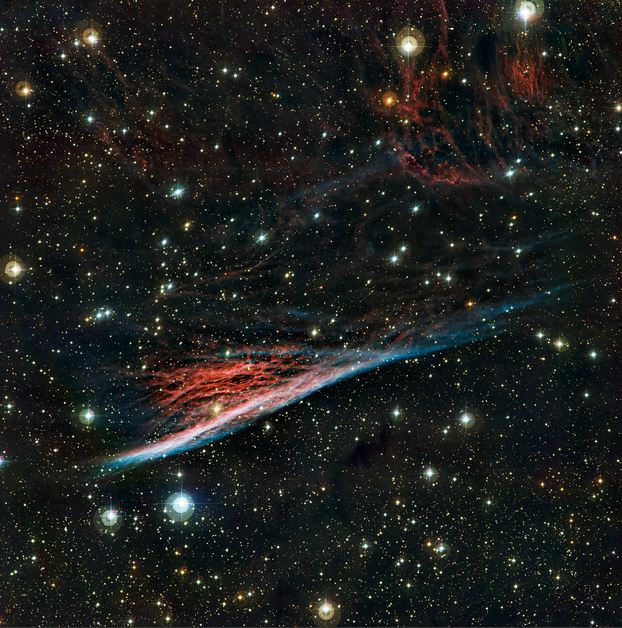
Pencil Nebula (NGC 2736) captured by ESO’s La Silla Observatory in Chile. Credit: ESO
This odd-shaped cloud of gas and dust is nicknamed the Pencil Nebula, as the brightest part resembles a pencil. But this pencil looks like it has hair, flying off into the breeze! But that’s no simple breeze: these glowing filaments in NGC 2736 were created by a supernova explosion that took place about 11,000 years ago, and they are moving through the interstellar medium at about 650,000 kilometers (403,000 miles) per hour.
[click to continue…]
[click to continue…]

Caption: The original Jodrell Bank Control Desk with view of the Lovell telescope. Credit: Anthony Holloway.
Dr. Tim O’Brien is Associate Director of the Jodrell Bank Observatory and a Reader in Astrophysics in the School of Physics & Astronomy at the University of Manchester. As we begin our tour of the telescopes, control room and computers he explains the role of Jodrell in the historical development of radio astronomy. The Lovell telescope at the heart of the observatory, is today a Grade 1 listed building as well as being at the cutting edge of current, and indeed future, scientific research. [click to continue…]
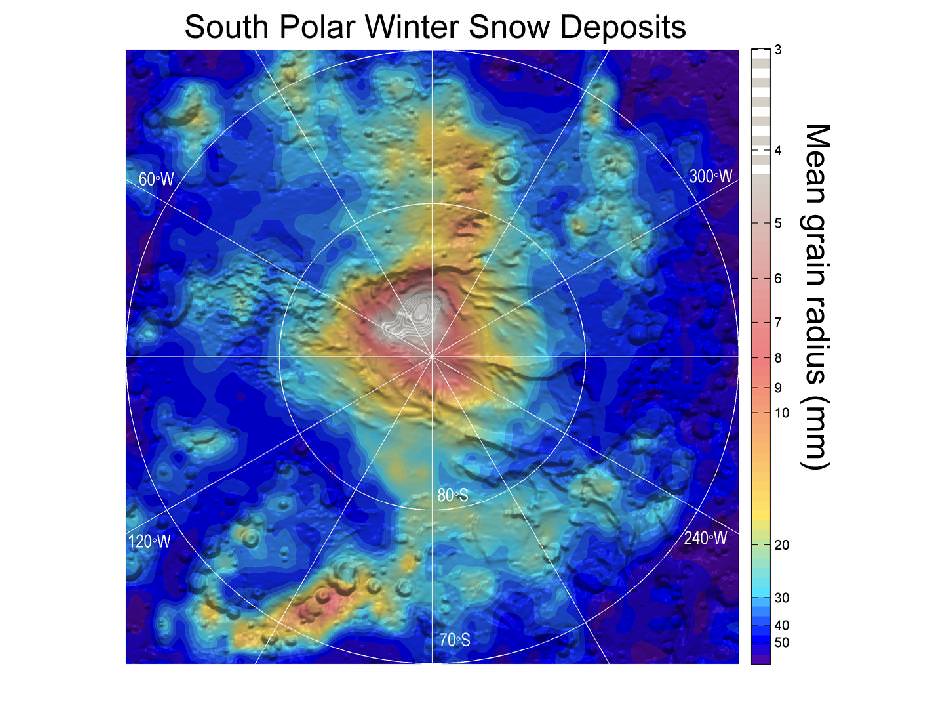
Observations by NASA’s Mars Reconnaissance Orbiter have detected carbon-dioxide snow clouds on Mars and evidence of carbon-dioxide snow falling to the surface. Image credit: NASA/JPL-Caltech
In 2008, we learned from the Phoenix Mars lander that it snows in Mars northern hemisphere — perhaps quite regularly – from clouds made of water vapor. But now, Mars Reconnaissance Orbiter data has revealed the clearest evidence yet of carbon-dioxide snowfalls on Mars. Scientists say this is the only known example of carbon-dioxide snow falling anywhere in our solar system.
“These are the first definitive detections of carbon-dioxide snow clouds,” said Paul Hayne from the Jet Propulsion Laboratory, lead author of a new study published in the Journal of Geophysical Research. “We firmly establish the clouds are composed of carbon dioxide — flakes of Martian air — and they are thick enough to result in snowfall accumulation at the surface.”
[click to continue…]
[click to continue…]
 Caught on webcam by amateur astronomer George Hall in Dallas, Texas, the impact on Jupiter that occurred yesterday at 6:35 a.m. CT can be clearly seen in the brief video above as a bright flash along the giant planet’s left side.
According to Hall on his website the video was captured with a 12″ LX200GPS, 3x Televue Barlow, and Point Grey Flea 3 camera using Astro IIDC software.
Great catch, George! Currently this is the only video footage we’ve seen of this particular event. Also, tonight at 10 p.m. ET / 7 p.m. PT the SLOOH Space Camera site will broadcast a live viewing of Jupiter to search for any remaining evidence of an impact. Tune in here.
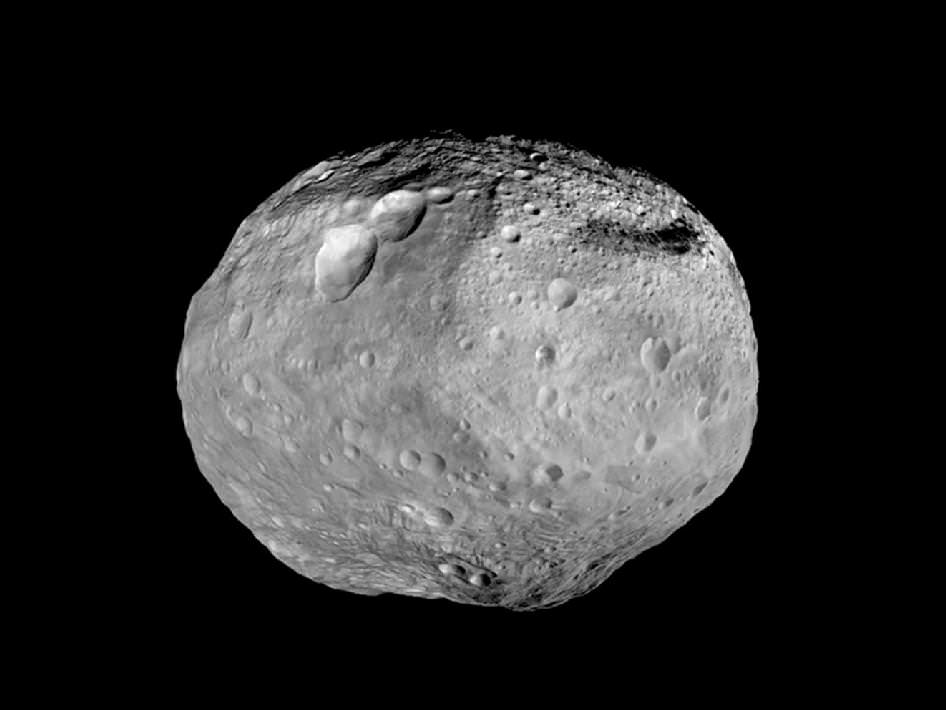
Dawn’s look at asteroid Vesta as the spacecraft heads off to Ceres. Image credit: NASA/JPL-Caltech/UCAL/MPS/DLR/IDA
As Dawn says goodbye to Vesta — where the spacecraft has been orbiting for over a year — here are two final views of the giant asteroid, which are among the last taken by the spacecraft, NASA said.
“Dawn has peeled back the veil on some of the mysteries surrounding Vesta, but we’re still working hard on more analysis,” said Christopher Russell, Dawn’s principal investigator at UCLA. “So while Vesta is now out of sight, it will not be out of mind.”
[click to continue…]
[click to continue…]
RELATED SEARCH
 Solar Chargers and Solar Panelsaarp.org
 Space Walk GalleryDiscovery.com
 Space Shuttle GalleryDiscovery.com
 Endeavour to Take to the Skies One Last Time
 Remembering Neil Armstrong: GalleryDiscovery.com
 Endeavour Unplugged - Last Picture Show from the Flight Deck of a Living Space Shuttle Orbiter
 Shuttle Discovery Mated to 747 Carrier for her Final Flight to Smithsonian Home
 Endeavour Astronauts Arrive at Cape for May 16 Launch
 Brainwashing GalleryDiscovery.com
 Era of Space Shuttle Endeavour Ends with June 1 landing at the Kennedy Space Center
Read more: http://www.universetoday.com/#ixzz26NIP9Hia
Solar Chargers and Solar Panelsaarp.orgSpace Walk GalleryDiscovery.comSpace Shuttle GalleryDiscovery.comEndeavour to Take to the Skies One Last TimeRemembering Neil Armstrong: GalleryDiscovery.comEndeavour Unplugged - Last Picture Show from the Flight Deck of a Living Space Shuttle OrbiterShuttle Discovery Mated to 747 Carrier for her Final Flight to Smithsonian HomeEndeavour Astronauts Arrive at Cape for May 16 LaunchBrainwashing GalleryDiscovery.comEra of Space Shuttle Endeavour Ends with June 1 landing at the Kennedy Space CenterRead more: http://www.universetoday.com/#ixzz26NIP9Hia
Read more: http://www.universetoday.com/#ixzz26N6qGHHV